Practicing Unforced
Reflections on Taiji - Form and Flow

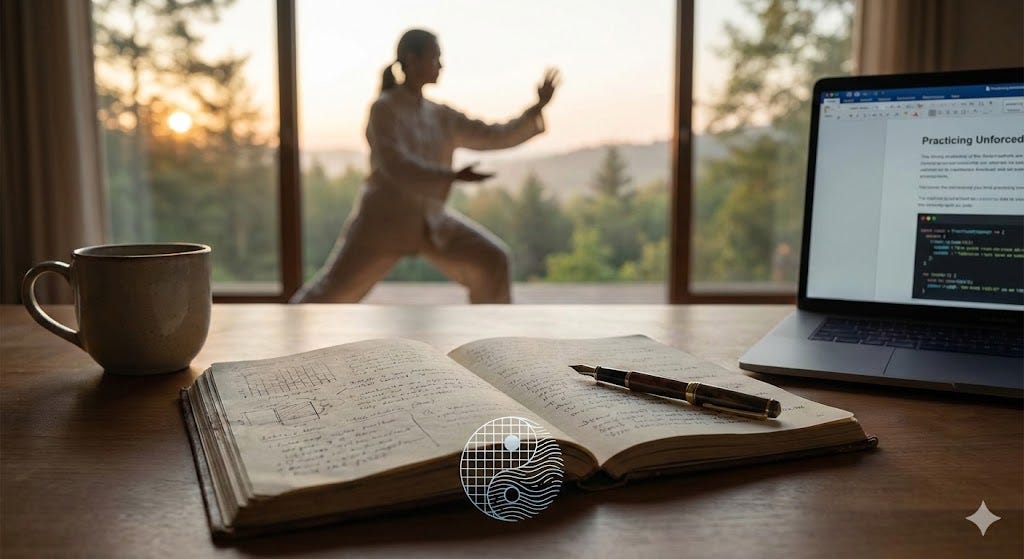
I am finally wrapping up my third semester out of four in my Creative Technology & Design master’s degree at CU Boulder. In many ways, this semester finishing up represents a major relaxation of structure. I tend to have some resistance towards structure, but also find a lot of value in it. Entering this program was a way of putting myself back inside of some structure because I knew it would support my growth as a technologist—and it has. Now I find myself ready to release some of that structure, fortunate because next semester is almost entirely self-directed.
The final days of the semester feel particularly structured. Lots of assignments with specific deadlines. Although it adds a beautiful generative pressure that I find incredibly motivating, especially given its temporal nature and the understanding that this time of pressure shall pass.
One of the last assignments I’m turning in is a practice journal for my Neurohacking class. The simple thing would be to make some basic notes about what my practice has been for the last month and turn it in. But I’ve felt compelled to interpret “practice journal” differently—to practice some deep reflection on my relationship to practice itself. This has synchronized well with a Taiji class I’m auditing at Naropa, where I was invited to write a paper on Taiji. And so here is both: my practice journal and my Taiji paper, meshed together in the form of a post on my blog.
So where shall we start?
—
The first time I took LSD, I was journaling a lot, so intrigued by what was occurring in my mind. I found myself messaging my dad Joe—who was a bit of a psychonaut himself back in the day—to share my journal entries and what I was experiencing. He was pleased and amused, but he also advised me not to miss out on experiencing the trip for want of recording it.
This was solid advice and it stays with me today as I reflect on what constitutes an effective practice of self-reflection. How much does jotting down notes about my Taiji practice every day help my Taiji practice, and how much does it actually distract me from the experience of the practice? I don’t think there’s an easy answer, because the truth is that it changes, and quite frequently. There are times where being more consistent and structured in my reflection is incredibly supportive, just as there are times where structure in my Taiji practice itself is supportive. But it’s not always the case.
Joe was a Taiji teacher, and this question of when structure supports versus when it constrains is one I’ve been living with my whole life—even before I had words for it.
—
I’ve been pretty consistent about doing Taiji every day; it’s rare that I don’t do it as one of the first things when I wake up. But my Taiji practice is not a static thing. I have two different forms that I practice, and sometimes one takes priority over the other. I’ve also been deepening into simple standing practice, which creates a nice foundation for everything else. And often I prefer to release the form entirely and find my own Taiji through dance. Taiji for me is such a dynamic practice that I’m always hesitant to trap it too much in a specific form. And yet, I can’t deny that form—even a very structured one like the Yang style 37 form as taught by Cheng Man-ch’ing—can be incredibly valuable.
Having recently taken a week or two of doing more standing and dancing, and then returning to the 37 form, I found the structure brought vital support to my system, reinvigorating a deep desire for discipline. But one of the reasons I’d stepped back from the form is that the discipline had begun to feel rigid.
This is where my two teachers offer different gifts.
The Yang 37 form I’m learning at Naropa is precise. This precision has advantages: when something is exact, it becomes easier to communicate about. Everyone is doing things approximately the same way, so specific refinements—where you place your weight, how you shift—can be explicitly transmitted. This is helpful for learning fundamentals.
But precision has limits. When we get too caught in form, we start to think Taiji is just that thing we do for ten minutes in the morning, forgetting that Taiji is every moment of our lives.
This is something I appreciate about the other form I practice, learned from Chungliang Al Huang. Chungliang has been my main Taiji teacher for the last three to four years, and my mother Laurie has practiced with him for about ten years. He studied with many masters, including Cheng Man-ch’ing, but he was also a dancer with a strong background in choreography. When he created the form he now teaches, it was for dancers—simpler, easier to follow. The form has adapted and changed many times over the years, much to the consternation of long-term students who might wish for more consistency. But Chungliang is always concerned about his students getting too lost in the form. We become obsessed with right and wrong ways, and we forget what the purpose of Taijiquan actually is.
—
Taijiquan—the slow rhythmic movements you might see practiced in a park—is a tool. The goal of Taijiquan is for us to understand Taiji. Taiji is often translated as “supreme ultimate,” though I prefer “great polarity.” Taiji is yin-yang: the interwoven dance of opposites. Inward and outward, full and empty, giving and receiving, whole and part. We flow through the sequences of Taijiquan to cultivate awareness of this inseparability, to grow attentive to the whole of life and our part in it.
The flowy way of doing Taijiquan and the more structured way are themselves a demonstration of Taiji—the dance of opposites, right there in how we practice. We have to find our own relationship to structure, and be mindful of stories that we should do it this way or that way. When we get caught in should, we’ve missed the point.
—
While I only received one official Taiji lesson from Joe before he passed, he was gently guiding me toward Taiji my whole life—with consistent reminders to connect with my breath, move from my core, check my posture. And those were just the spoken reminders, not to mention all the ways he communicated simply through his being.
At times I’ve wished I had learned more formal Taiji from him while he was still around. But I’ve grown to love that I didn’t. By not forcing Taiji onto me, he gave me the gift of finding my own Taiji and falling in love with it in my own time. Now my understanding is uniquely my own, even if Joe played a tremendous part in facilitating it.
Joe’s way of teaching me has shaped how I relate to practice now. I suspect I will always practice some blend of the forms I’ve learned, always make up my own forms as I go, and whenever possible, drop form altogether.
—
For me, the essence of Taiji comes down to listening, opening, and exploring. I listen—not just with my ears—to actually understand who I am in this moment. I open, with all of my being, as I connect with the world around me. And I explore with curiosity, in stillness and in motion, this unfolding relationship between myself and the world I find myself in.
This is my practice as I flow through the sequences of Taijiquan. This is my practice as I dance my own spontaneity. And this is my practice as I sit and be with what is.
Unforced.
Beautiful, thank you <3 Love the inquiry into not missing the trip for the record. This question is the crux of all my life and art - beautifully, maddeningly so :-). Discipline and freedom! Love ya.