Practicing Radical Reorganization
Four years on

Today is April 23rd, 2026. It was 11 years ago that my dad Joe completed his time on Earth, after a two and a half year journey with glioblastoma. It was 4 years ago today that I published my thesis, Radical Reorganization, as I completed my Ecopsychology masters from Naropa University — a paper that in many ways honored my dad and the legacy and work that he passed on to me in his death.
And now today, as I approach the completion of my masters in Creative Technology & Design from the ATLAS Institute at CU Boulder, I am launching a project which I have worked on during my time here, Parachute.
This piece is my attempt to look at what’s happened in those four years — how the ideas in that paper have become the work I’m actually doing now, and how Joe’s philosophy keeps coming through all of it.
Since Joe’s passing 11 years ago, I have been intimately interested in this idea of a radical reorganization. What is the dominant paradigm our society is living in, and is there another way of living that is possible? And how might our actions and creations in the world support a movement towards a more beautiful world, while simultaneously addressing the existential risks that seem to face us in this time?
As I complete my second masters degree, I am present to two major parts of society in this transformation: education and business. In Radical Reorganization, I was looking at social systems as a whole, and then zooming into business organizations, communities, and groups. After immersing myself more fully in the education world — giving birth to my own learning program with Learn, Vibe, Build, and preparing to step into a role as a lecturer at CU Boulder — I find myself thinking more about how education can support this emerging worldview, and how education, when done well, can help bring forward the kinds of organizations and communities that carry this worldview into action.
Techne
This is some of the vision that I see emerging from the cooperative we’re building at the Regen Hub, our local co-working space. We incorporated as RegenHub LCA on February 6th, 2026; coincidentally on what would have been Joe’s 60th birthday (I had no control over this, but it felt like a little wink from beyond signaling that he’s a part of what we’re creating here). We’ve also been nurturing a new brand here at the Hub called Techne, exploring the idea of bringing forth the education community through the Techne Institute, and I’ve been increasingly finding myself referring to our co-op as the Techne Cooperative. Throughout this piece I’ll refer to both Techne and the Regen Hub — in my mind they’ve become inseparable.
Learn, Vibe, Build — our new program and learning community around AI — feels like some of the core DNA for this larger vision. As we help more people understand how to actually work with these tools, we grow the agentic capacities of our community, and work to keep that growing agency rooted in alignment with what we actually care about. LVB is also one of the main ways our community itself grows: new people come in, find a place to learn, and often stay to build alongside us.
There is a lot of conversation these days about the usefulness of traditional education, but one thing I hear again and again, and know in my own experience, about one of the benefits of traditional education, is that it gives you a playground in which to explore. For 4 years, you are able to be in a place where your core orientation is to learn; and this enables a level of collaboration that is seen less often in the default world, where we are constantly wrestling over who owns what and who gets to derive the benefit from our creations. In school, we have the world view that we are creating to learn more than anything and this fosters a different kind of culture around ownership.
At Techne, I see us working to create a culture that supports this level of collaboration. While we recognize that we live in a world still shaped by capitalism, and that the idea of ownership has its place, we largely orient from a generosity and give first perspective, sharing our ideas freely with each other and trusting that the success of any one of us benefits all of us.
This give-first orientation is something Joe was living long before I had language for it. He was a carpenter by trade, and his art was shaping homes the people inside them would love. He was also a teacher of taiji — the practice of moving with the natural flow of things, of unforced action. He gave generously — to his family, his clients, his students, his community. A lot of what we’re trying to build at Techne is inspired by what I saw Joe living — an attempt to practice, at the scale of an organization, something like what he embodied in his own life. I don’t know yet whether we’ll get there. What I know is that we’re trying, and that the trying feels right.
And as we grow we are even working to codify this more directly, creating structures wherein as we bring forth ventures, we offer some ownership of our ventures directly to the cooperative, to further incentivize us to support each other, because as we are all growing in our ownership in the cooperative, that means we are also growing in our ownership of all of the ventures emerging from within the cooperative.
Parachute
One such venture where we are beginning to pilot this shape is with Parachute, a company that I have been working on birthing for about the last year, and which launches today. While the specifics of the arrangement are still being landed, the intention is for the cooperative to own at least 10% of the company and potentially much more. The company is also being created primarily by members of the cooperative and so the incentives are deeply aligned. And yet by still being an independent venture it enables us to raise money in more traditional ways and to grow in faster and more autonomous directions; while being able to use that success and speed to benefit the cooperative as a whole.
Parachute is not unique in building a mutually beneficial relationship with the cooperative. One of our core founding members, Kevin Owocki, is the founder and executive director of Gitcoin, and has been continuing to work on building a mutually beneficial relationship between Gitcoin and the cooperative, supporting effective flows of capital as well as labor that supports Gitcoin’s success and the cooperative’s growth. And it’s not only the relationship of labor and capital that are able to increase our effectiveness. It’s also the development of tooling that is directly useful for the cooperative, while the cooperative gives to the ventures the earliest adopters of the technology.
This is very true with Parachute. We’re building open, interoperable tooling for extended cognition; today we’re launching Parachute Vault and Parachute Notes as the first pieces. I’ve written a separate post about what we’re building and why, so I won’t detail it here. What matters in this context is just this: Parachute is exactly the kind of tool our cooperative needs to be coherent, and the cooperative is exactly the kind of community Parachute needs to be built well. The loop is mutual.
And as the cooperative supports education offerings such as Learn, Vibe, Build; we are able to directly support more people using the tools that we ourselves are building, helping those people become more effective but also helping the tools grow through direct user feedback as we get a direct view into how people are leveraging AI. These are just a few examples of the kind of mutually beneficial upward spirals that we are catalyzing within the cooperative. And this is all part of the bet that increasing openness and collaboration is necessary not just to thrive in this ever-changing world, but to also be part of a new paradigm emerging that truly supports the living systems of this planet.
Woven in
What we’re trying to build is what the physicist Ilya Prigogine called an “island of coherence” — a small integrated system that, in times of chaos, can help shift the larger system toward a higher order. But it only works if it’s woven in. A coherent island in isolation doesn’t reorganize the world. A coherent island connected to a larger fabric might.
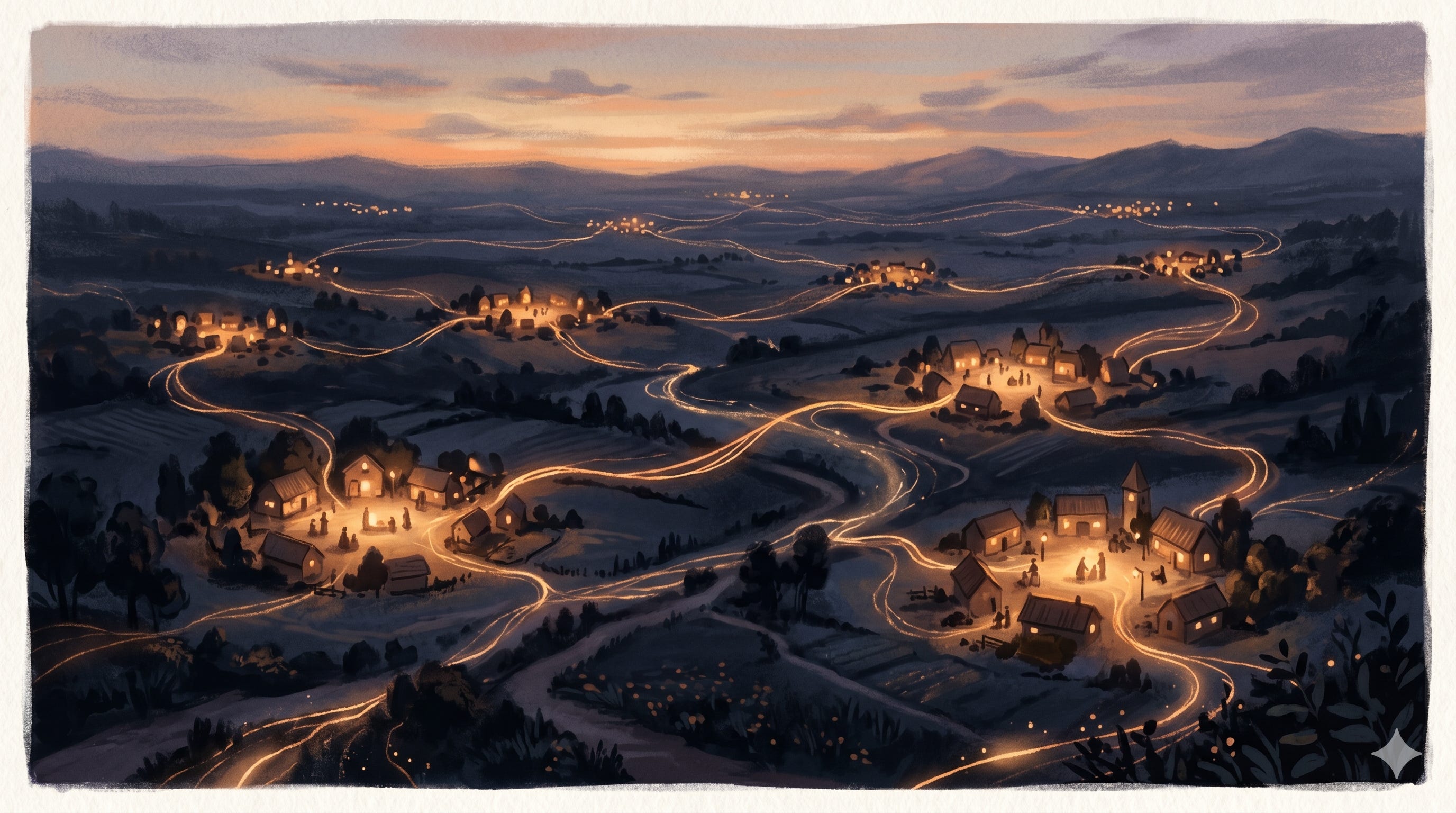
And the bet that we’re making here is not just about us, not just about our ventures, not just about our cooperative, not even just about our city Boulder. We’re making a bet on a larger movement that we see ourselves as part of. And it’s a movement towards connection, towards openness, towards a recognition of our mutual interdependency, and towards a re-organization and re-orientation of our society and of our systems to align with that recognition. This is why we are building from the spirit of openness. Everything in Parachute is built open-source and is intended to be built on top of, forked and modified to enable anybody to create the systems that they need. Likewise we are sharing as much as possible of our blueprints with Learn, Vibe, Build; Techne; and everything else, to enable others to learn from us, just as we are learning from others.
This is part of a wider vision that we refer to as Cosmo-Local, building a lot on the work of Michel Bauwens who popularized this term. It means that that which is heavy should be local; we should be building local relationships and sharing resources locally. But that which is light should be cosmo — shared far and wide, helping us all collaborate better together from wherever we are. (I wrote more about this approach in Build for Here.) Here at the cooperative, we see ourselves as part of this wider movement, and we already know of a huge network of collaborators throughout the country and the world who are working on the same mission from their own locality; and we also know that there is a much much wider network of collaborators that we are not even vaguely aware of.
Today
In Radical Reorganization, I articulated a philosophy and an understanding of our interconnectedness and of how we can participate in different ways to affect a change in paradigms that moves us towards a society that truly recognizes this. And now, 4 years later, I find that the theory has transformed into a practice, and I am part of a cooperative that is embodying these very ideas. We are working together, sharing freely and openly, learning and educating, collaborating and building; and helping to foster radical new ways of organizing ourselves.
This is the radical reorganization, and we’re all part of it. It’s up to each of us how we show up for it — locally with us here, or in your own place with your own people. If any of this resonates, I’d love to hear from you.
Eleven years gone, but more present than ever. Unforced.